


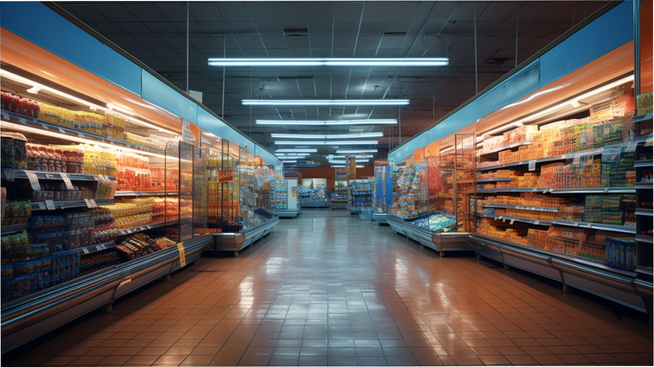
Category management might be the most data-rich function in retail, and it still can't answer its most basic question: what actually happened in the store, at the shelf, in the real-life moment of truth.
This isn’t about what made it across the belt, at which quantity for how much. This isn’t about post-visit sentiment surveys or what flavors are trending on TikTok. This is about knowing with complete conviction what actually happened in the moments a purchase decision was made. And the truth is, most teams operate without this basic level of visibility.
That’s the blind spot. And it’s worth naming because of how many other decisions rest on top of it: assortment, planogram optimization, aisle adjacencies, price and promotional strategy. Every one of those decisions is meant to be built around the shopper. But you can't build around a shopper you can't actually see.
Understanding shopper behavior data can help category teams move beyond purchase outcomes and gain greater visibility into what happens throughout the in-store shopper journey.
Proof of what, before why
The instinct, when a category underperforms, is to go straight to "why." Why did the reset underperform? Why did we lose share to the brand next to us on the shelf? It feels like the right place to start.
It isn't — because "why" assumes you already know what happened. Most of the time, you don't. You know what got scanned. You know what shoppers told you after the fact. Neither one shows you the moment the decision was actually made. Get the "what" wrong, and every "why" you build on top of it is wrong too.
Online retail solved this years ago. An e-commerce site doesn't just know what you bought — it knows what you searched, what you compared, what you abandoned in your cart, how long you lingered before you clicked away. In-store, those moments have always been out of reach. Until recently, the physical shelf has been the one part of retail where the entire middle of the story stays invisible.
That missing visibility is particularly important for teams using category management strategy to influence shopper decisions at the shelf.
The third signal
Most category strategy today runs on two signals: scanned data (the receipt — what sold, when, where, at what price) and reported data (the context — surveys, focus groups, the story shoppers tell you afterward). Together, those two create the illusion of a full picture. Still, neither one of those end points hold proof of what happened in the middle.
The missing piece is observed behavior: the real-world evidence of how shoppers actually shop.
Observed behavior provides a direct view of in-store shopper behavior, helping retailers and brands understand how shoppers navigate, engage with categories, and make decisions in the physical store.
Observational research has long been considered the gold standard of market research, and for good reason. Observational research lets you observe without interfering, which offers the most bulletproof analysis of in-store performance. VideoMining’s patented AI and computer vision tools capture billions of shopping journeys each year, decoding the raw micro-moments that define decision-making and offering concrete proof of what happened under what circumstances.
That’s the foundation of shopper truth: it’s rooted in fact.
This behavioral evidence can complement traditional shopper research, purchase data, and other retail analytics to create a more complete picture of the path to purchase.
Once you see what actually happened, it’s a lot easier to answer the questions that follow. BehaviorSync™ harmonizes observed behavior with scanned purchase data and reported consumer context, offering the big-picture perspective you’ve been missing.
Behavioral evidence in practice: Wells Enterprises
The clearest way to see this in action isn't hypothetical. Wells Enterprises put this framework to work for the ice cream category, tailored to the unique experience of each retail channel. Same category, same company, same behavioral discipline applied twice – in convenience and grocery.
The full diagnostic, and the tactics that followed, are outlined in the full case study.

Four principles to lead with
Category lead Kristi Simmons, of Wells Enterprises, recently joined VideoMining CEO and Founder, Rajeev Sharma, in a CMA|SIMA Webinar outlining this approach.
As Simmons explained, a behavioral finding isn't an answer on its own — it's a door. The metric tells you something's happening; the questions you ask next tell you what to do about it. Across every category we've worked through, Simmons’ four key principles hold up:
-
Know your shopper. Who's actually deciding, and when? Design for the real demographic and daypart and mission— not the average shopper, who doesn't exist.
-
Know your channel. The same category can present opposite problems in different channels. Let behavior mold the playbook, rather than taking a cookie-cutter approach.
-
Test the levers — don't inherit them. Placement, merchandising, timing: these are decisions you validate behaviorally, not through assumptions you carry forward because they've always been there.
-
Keep behavioral KPIs at the center of the table. Look at this not as a one-time study — but a continuous baseline. It's what guides internal strategy, and increasingly, it's the evidence base that changes the conversation with retail partners.
Together, these principles provide a practical framework for applying behavioral shopper insights to category management strategy.
Going Beyond
The same visibility that unlocks category strategy doesn't stop there. The moment you can see what's actually happening in-store, it changes how you think about the functions sitting alongside to category management:
Shopper marketing - get direct visibility into what a display, a promotion, or a retail media placement actually does to the funnel — a real read on ROI, not an assumed one.
Brand innovation - get moment-of-truth insight into how shoppers compare brands at the shelf, whether they stay loyal or actively switch — which doesn't always match what they'd tell you outside the store.
Store optimization - gets a behavioral basis for evolving the physical store to match a shopper who now has more choices than ever, in-store and online.
These applications demonstrate how shopper behavior data can extend beyond category management into shopper marketing, brand strategy, retail media measurement, and store optimization.
Different functions, same underlying question: what actually happened, and what do we do about it.
What’s Next
Behavioral evidence isn't just how you run a category — it's how you lead the conversation with the partners on both sides of the table, internal and external. The tools to answer "what happened" at the shelf, with the same rigor retailers have had online for two decades, finally exist. The question is will use them first, and who will use them right.
We unpacked all of this — including the full Wells Enterprises walkthrough — in a recent session with the Category Management Association.

Or skip straight to the specifics:

Explore More Content
Popular Articles




.png?width=352&name=Copy%20of%20Copy%20of%20Gradient%20-%20VideoMining-InstaPosts%20(34).png)