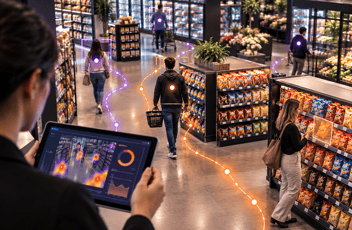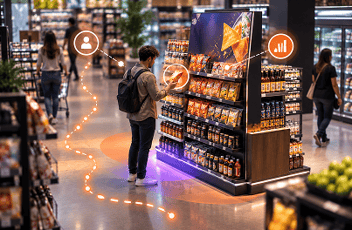
Retailers and CPG brands invest heavily in pricing, promotions, merchandising, and assortment to influence purchasing decisions. Yet despite these investments, a significant share of active shopping moments still ends without a purchase.
Across the grocery channel, VideoMining consistently observes that nearly 45 out of every 100 shoppers who actively engage with a category leave without buying anything. This isn't simply a merchandising issue—it's a shopper experience issue.
Every decision shoppers make inside the store is shaped by what they encounter along the path to purchase. Store layout, product visibility, category organization, and moments of friction all influence whether shoppers continue toward a purchase or walk away. Understanding these behavioral moments is essential for improving shoppability, increasing trip value, and strengthening shopper loyalty.
What Is Shoppability?
Shoppability refers to how easily shoppers can discover, evaluate, and purchase products throughout the shopping journey. It encompasses store layout, product visibility, category organization, signage, merchandising, and every interaction that influences the path to purchase.
For retailers and CPG brands, improving shoppability means removing friction and creating an environment where shoppers can confidently complete their intended purchases while discovering new opportunities along the way.
Why Shopping Trips Are Changing
Before we talk about the experience in store, it helps to understand the context of the shopper’s reality.
Over the past four years, the structure of the grocery trip has shifted meaningfully. Average units per trip have declined from 11.3 to 9.8. Stock-up trips — those large, category-spanning missions where shoppers fill the cart — have dropped from 17% to 13% of all purchases. Quick trips of just 1-4 items now account for 52% of visits.
Shoppers are spending roughly the same amount of money. They're just buying fewer things, in shorter trips, with less margin for error...and less tolerance for disruption.
For retailers and brands, this means there are fewer opportunities per shopper per trip to earn a sale. And when the trip is tighter, the in-store experience matters more — not less. A confusing shelf, a hard-to-navigate aisle, a display that stands in the way but doesn’t even earn a glance: these aren't minor inconveniences. The challenge extends beyond shorter shopping trips. Even when shoppers intend to buy, loyalty alone doesn't guarantee a purchase.
Why Shopper Behavior Matters
Every shopping trip reflects a series of behavioral decisions rather than a single purchase event. Shoppers constantly evaluate products, compare options, respond to merchandising, and adapt to the store environment.
Understanding these decisions helps retailers identify where shoppers hesitate, disengage, or abandon purchases, enabling targeted improvements that increase conversion and strengthen loyalty.
Why Shopper Loyalty Doesn't Always Lead to Purchases
Here's a behavioral truth that gets lost in most loyalty conversations: a shopper can be a loyal consumer of a brand and still walk past it in the store, or worse, replaced by a competitor product in the moment of choice.
To a certain extent, brand loyalty lives at home. It needs to be earned, once again, on the shopping trip.
What’s more, store loyalty (channel and banner) needs to be earned and protected within every aisle and every micro-moment of the shopping experience.
According to FMI's U.S. Grocery Shopper Trends 2026, shoppers visit more than five separate grocery banners per month on average. They're not locked in. They're constantly re-evaluating whether the store is working hard enough for them. Still, 32% say they'll pay a premium just to avoid having to shop multiple stores. That's a loyalty premium waiting to be earned — or forfeited.
What earns that loyalty? Some might say ease of shopping, or efficiency of total trip time, or product availability, or moments of surprise and delight. In other words: the experience.
This is where the shopper experience begins to influence retail performance in ways that transaction data alone cannot explain. While loyalty and intent bring shoppers into the store, what happens during the shopping journey ultimately determines whether those intentions become purchases.
How In-Store Friction Reduces Sales
The reality is that friction rarely shows up when you know to look for it, and usually remains undetected until you’re forced to enter damage control mode.
When a shopper enters a category, spends sixty seconds searching, and leaves without buying — nothing flags in the sales data. No fire alarms go off when the sale that could have been simply doesn’t occur.
This blind spot has plagued brick-and-mortar retail for decades. Digital commerce cracked this code decades ago — every browse session, every abandoned cart, every 87-second product consideration is captured, analyzed, and acted on. The physical retail store has had no equivalent insight: what happens in the aisle stays in the aisle.
Similarly, traditional in-store shopper insights have left a massive blind spot in attribution modeling: what metric tells you that a big-bet secondary display, built and executed by sizable brand investment – was actually glanced at by only 1 out of every 10 shoppers who walked by? Furthermore, what metric tells you that the same display in a different placement generated nearly 4x buyers per 100 store visitors
Understanding these invisible moments requires more than traditional retail metrics—it requires observing shopper behavior as it happens.
What Shopper Behavior Really Reveals
Here's what behavior tells us: the store is full of signals that most brands never see.
VideoMining has spent over a decade observing billions of annual in store shopping trips — every glance, every hesitation, every moment of engagement and decision, captured at 1/10 of a second. That's not just robust data collection. It's the construction of the most comprehensive record of shopper behavioral science in retail history. And it's what our AI and shopper research tools are built on.
When there is friction point in the shopping experience, we don’t have to guess. We recognize.
One of the most consistent findings from VideoMining’s in store shopper research, captured through observational research in real stores throughout the U.S. is this: a significant portion of lost sales has nothing to do with the product itself. It has everything to do with how the store is experienced.
The shopper who picked up your brand, read the label, and put it back on the shelf wasn’t necessarily rejecting your brand. The shopper who never even glanced at your impressive lobby display wasn’t necessarily indifferent to your campaign. The shopper who intended to purchase your product and then got sidetracked by an attractive category adjacency hasn’t necessarily abandoned ship.
These examples highlight the myriad of problems that could be chipping away at your performance; and each require a very different solution. But first, they are all only visible when you start asking what actually happened in the moments that matter.
That's where experience optimization begins: with the behavioral truth of what the shopper actually did.
Conclusion
Retail success isn't determined solely by pricing, promotions, or product assortment. It's shaped by every interaction shoppers experience along the path to purchase.
By understanding shopper behavior instead of relying solely on transaction data, retailers and CPG brands can uncover hidden opportunities to improve shoppability, reduce friction, and strengthen shopper loyalty.
Curious what's really happening inside your stores?
Contact VideoMining to learn how shopper behavior insights help retailers improve shopper experience, optimize shoppability, and increase in-store conversion.

SUGGESTED RELATED LINKS:
Explore More Content
Popular Articles